
In this episode of the podcast, Billy Dees sits down with Canadian author Cinda Gault for a sweeping, thoughtful conversation that moves fluidly between literature, feminism, history, politics, and culture. What unfolds is not just an interview about books—it’s an exploration of how identity is shaped, challenged, and remembered across decades.

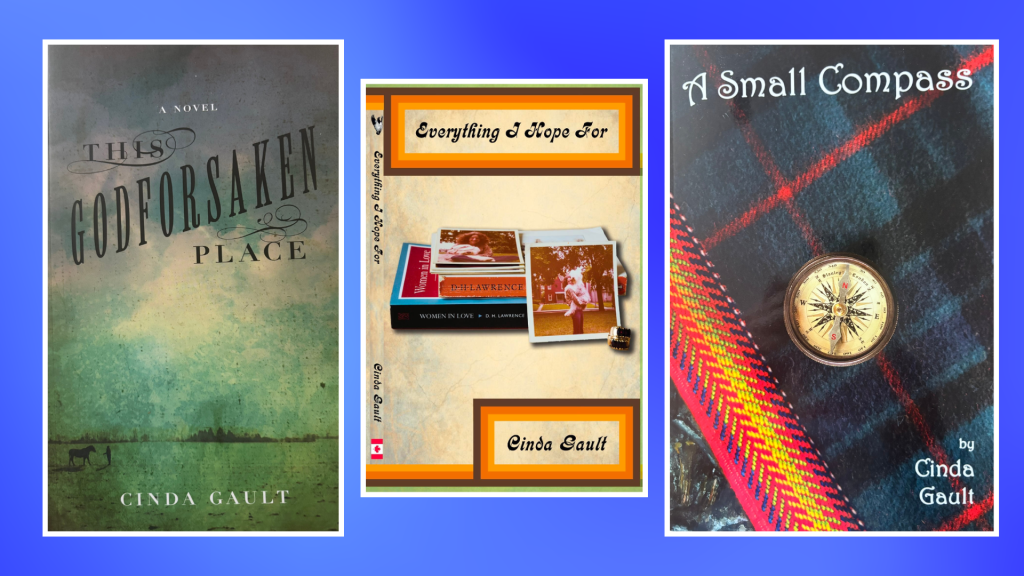
Cinda Gault, author of This Godforsaken Place, A Small Compass, and Everything I Hope For, brings a rare combination of lived experience, academic rigor, and storytelling instinct to the microphone. The result is a dialogue that feels both deeply personal and intellectually expansive.
From Feminist Activism to Fiction
Cinda Gault’s journey to fiction didn’t begin with dreams of literary fame—it began with activism.
As a young woman in 1970s Canada, she was immersed in second-wave feminism, helping establish rape crisis centers and shelters for victims of domestic violence. Armed with an undergraduate degree in psychology from the University of Guelph and later an MA in criminology from the University of Toronto, she worked in social services—including a stint as a prison guard in a men’s prison.
Eventually, she discovered something important about herself: she didn’t want to manage people—she wanted to tell stories.
Her first published novel, a Harlequin Super Romance released in 1988, emerged from that realization. Writing romance, she notes, is far trickier than people assume. Getting two characters to fall in love is easy. Keeping them in meaningful conflict for 350 pages—without making either look foolish—is the real craft.
Years later, revisiting that manuscript (originally typed on a manual typewriter) became a meditation on how technology changes—but human emotion doesn’t. The landlines, phone booths, and tape recorders had to be updated. The romance itself held steady.
“People fall in love now the way they always have.”
The 1970s: A Divided Memory
One of the episode’s most compelling segments centers on the 1970s.
Billy recalls childhood freedom in the United States—bikes, Evel Knievel ramps, and a life lived outdoors without screens. Cinda Gault, by contrast, remembers a “heady” period of political awakening as a university student in Canada.
Under Prime Minister Pierre Trudeau, Canada experienced a surge of nationalism alongside second-wave feminism. For women, the era meant access—to education, to careers, to autonomy. The birth control pill became widely available. Women entered professions previously closed to them. University enrollment patterns would eventually flip from male-dominated to female-majority.
Yet the conversation avoids nostalgia traps. Both host and guest reflect on how movements evolve—and sometimes overcorrect.
Cinda Gault observes that the feminism of her generation was rooted in a simple demand: “Get out of my way.” It was about autonomy and responsibility. Today, she suggests, identity politics has sometimes shifted from equality to equity in ways that complicate that earlier clarity.
It’s not a condemnation—but a generational reflection.
Canada, Autonomy, and the Abortion Question
One of the most illuminating moments in the episode comes when Billy raises a surprising fact: Canada is the only Western nation without a federal abortion law.
Cinda Gault explains the history, referencing the legal battles of Dr. Henry Morgentaler and the 1988 Supreme Court decision that struck down Canada’s abortion law. Unlike the United States—where abortion remains a central, polarizing issue—Canada’s legislative structure and constitutional culture have produced a different outcome.
She ties this to Canada’s unique national formation: a country born from compromise between French and British identities. Without a singular cultural narrative like America’s “melting pot,” Canada evolved with an instinct toward pluralism—“leave people room.”
The discussion is nuanced and civil. Rather than turning partisan, it becomes a reflection on how national identity shapes law, and how literature reflects cultural undercurrents long before legal systems codify them.
Music, Community, and Cultural Shifts
From politics, the conversation pivots to music—another defining force of the 1960s and 70s.
Billy recalls the communal experience of gathering around a hi-fi system to listen to new albums—music as event, as conversation, as cultural glue. Cinda Gault agrees, recounting how even her children were stunned by the originality of albums like Abbey Road.
Both acknowledge that while good music still exists, the shared cultural moment has fractured in the age of earbuds and streaming algorithms.
It’s a subtle but powerful theme of the episode: technology advances, but something communal may be lost.
History, Myth, and What Survives
Cinda Gault’s historical fiction is rooted in a central question: What survives history—and what doesn’t?
She shares the story of discovering an obscure footnote about Isobel Gunn, a woman who disguised herself as a man to work for the Hudson’s Bay Company in the early 1800s and was only discovered when she gave birth in a remote trading post.
The archival records detail weather, cargo, employee duties. What they don’t record are hopes, fears, motivations—the interior life.
That’s where fiction steps in.
Her comparison of Annie Oakley to Wayne Gretzky becomes emblematic of her approach: recognizing excellence and complexity beyond political alignment. Oakley, she notes, embodied strength and independence—yet wasn’t aligned with feminist movements. History doesn’t always fit ideological boxes.
The conversation even touches on figures like Jesse James, exploring how cultural memory can romanticize criminals depending on who tells the story. It’s a reminder that mythmaking is as much about identity as it is about fact.
Identity, Progress, and Personal Responsibility
Perhaps the most resonant theme of the episode is balance.
Cinda Gault acknowledges that major gains were made in women’s rights during her lifetime. She also questions whether modern discourse sometimes forgets that progress has occurred. Billy echoes this, suggesting that refusing to acknowledge improvement can make meaningful reform harder.
They agree on one key principle: equality ultimately means seeing one another as individuals.
It’s a rare moment in modern media—an honest, respectful exchange across national and generational lines without shouting, slogans, or caricature.
Final Thoughts
This episode stands out not just for its literary insights, but for its tone. It’s curious. It’s measured. It’s exploratory.
Cinda Gault brings academic depth, activist history, and storytelling passion to the discussion. Billy Dees brings cultural reflection and a willingness to ask hard questions without hostility.
Together, they create something increasingly uncommon in today’s media landscape: a long-form conversation that trusts the audience to think.
For readers interested in historical fiction, Canadian identity, feminism, or simply how stories shape nations, this is an episode worth hearing—and Cinda Gault’s books are worth reading.
 Perfect Media Productions, LLC