

History is full of facts.
It is also full of things that never happened.
And that’s where things get interesting.
On the latest episode of the Billy Dees Podcast, I sat down with Jon A. Gegenheimer, a longtime attorney, elected court official, and author whose books take readers into the sometimes uncomfortable territory where history, fiction, law, morality, and human nature collide.
Gegenheimer describes his approach to historical fiction as essentially fact packaged as fiction. His novels are heavily researched and footnoted, with real historical people, places, events, and ideas providing the framework for stories that also allow room for imagination.
And then there is the bigger question:
What if?
That question sits at the center of his latest book, Churchill vs. Hitler: The Untold Golf Match That Changed History.
Yes, you read that correctly.
A golf match.
Between Winston Churchill and Adolf Hitler.
Three months before Hitler invaded Poland and World War II began.
The match never actually happened. That’s the point.
Gegenheimer’s alternative-history novel takes an event that could have happened, places it against a meticulously researched historical backdrop, and asks what might have followed. The story incorporates figures including Churchill, Sigmund Freud, Bernard Darwin, and Ian Fleming while exploring how Churchill’s supposed golf match with Hitler becomes a template for understanding his eventual confrontation with Nazi Germany.
It’s a fascinating premise because alternative history isn’t really about pretending the past was different.
It’s about understanding how easily it could have been different.
A Lawyer Who Became a Novelist
Gegenheimer’s background makes his approach to storytelling particularly interesting.
He spent decades working in law, including complex litigation, criminal law, bankruptcy, title law, and other areas of practice. He later moved into the administrative side of the court system, where he became involved in bringing technology into the justice system.
That legal background naturally finds its way into his fiction.
Trials, evidence, competing arguments, moral choices, and the consequences of decisions are recurring elements in his books. His novel The Griffin Murders, for example, is a murder mystery involving a Louisiana Supreme Court justice, a U.S. attorney, a series of murders, and a contentious issue involving the separation of church and state.
In other words, this isn’t simply fiction written by someone who happens to like history.
It’s fiction written by someone who has spent a considerable portion of his life watching people make decisions—and then deal with the consequences.
That’s fertile ground for a novelist.
Katrina, Creativity, and Starting Over
One of the more interesting parts of our conversation was how Gegenheimer became a writer in the first place.
Hurricane Katrina devastated New Orleans and disrupted virtually every aspect of his professional and personal life. With the courthouse shut down and his normal routine interrupted, he began looking for something productive to occupy his time.
Writing became part creative outlet, part intellectual exercise, and, as he described it, potentially a form of therapy following a traumatic experience.
His first major project grew from that period.
He began with September 11, 2001, and imagined a story extending decades into the future. The result was a futuristic work of historical fiction that attempted to project how history might unfold over several generations. Interestingly, some of the events he imagined in 2010 ended up looking less fictional as the years passed.
That’s another intriguing aspect of writing about the future:
Eventually, the future gets here.
And then you find out whether your imagination was actually imagination—or just a strangely early appointment with reality.
Churchill, Hitler, and the Problem With “What If?”
Our conversation eventually turned toward Winston Churchill and the question of leadership.
Gegenheimer’s interpretation of Churchill centers on his willingness to confront Hitler rather than appease him. He draws parallels between historical events surrounding World War II and contemporary questions about leadership and negotiation. Those comparisons are part of his broader interest in how lessons from history can inform the way people think about the present.
But the more interesting issue isn’t necessarily whether every historical comparison is perfect.
It’s the exercise of making the comparison.
History gives us the benefit of hindsight. Leaders don’t have that luxury.
They have incomplete information, competing advice, political pressure, personal biases, and sometimes only a narrow window in which to make a decision.
Then history gets to grade the paper.
That is one reason the “what if?” question can be so useful. It forces us to think about contingency—the possibility that a different decision, a different personality, or a different event could have produced a dramatically different outcome.
The Moral Dilemma
Another major theme of our conversation was morality.
Gegenheimer believes fiction can do more than entertain. He wants his stories to make readers think about reason, morality, competing perspectives, and the consequences of attempting to justify actions simply because someone believes the desired outcome is worthwhile.
That gets into one of the oldest questions in philosophy:
Does the end justify the means?
It’s an easy question to answer when you’re sitting comfortably on the sidelines.
It gets considerably harder when you’re the person standing in the middle of the dilemma.
That’s where good fiction can become more than escapism. Put a character into a situation where every available choice has consequences, and suddenly the reader has to participate in the decision.
There may not be a comfortable answer.
There may not even be an obvious answer.
And that’s exactly why moral dilemmas make good stories.
You Don’t Have to Quit Your Day Job to Write
There was also a practical side to our conversation that I think aspiring writers will appreciate.
Gegenheimer has written five stories over roughly two decades while maintaining his professional career and family life. His advice isn’t particularly glamorous—and that’s probably why it’s useful.
Write when you can.
Use the time you have.
Accept that some days—or even longer stretches—nothing may get written.
Then start again.
He describes writing as an incremental process and emphasizes persistence rather than expecting a first book to magically become a bestseller.
That’s probably good advice for almost any creative endeavor.
The glamorous part is publishing the finished work.
The unglamorous part is everything that happens before that.
History, Fiction, and a Crazy World
Near the end of our conversation, Gegenheimer talked about a future nonfiction project focused on a contemporary political figure and the events of the 21st century. He also discussed the growing role of artificial intelligence and his efforts to understand how AI might be incorporated into court functions while maintaining human oversight.
And that brought us right back to where the conversation began.
History.
Because we’re living through it.
Every day.
The strange thing about history is that people living through it rarely know which moments will eventually become the chapters everyone studies.
That’s the advantage of looking backward.
The disadvantage is that we don’t get to do that while we’re making the decisions.
Maybe that’s why books like Gegenheimer’s are interesting. They allow us to step outside the timeline for a moment and ask a question humans have been asking forever:
What if?
What if someone made a different decision?
What if a meeting happened that never happened?
What if two historical figures sat across from each other?
What if one event occurred three months earlier—or never occurred at all?
You can argue with the answers.
You can question the assumptions.
You can disagree with the author’s interpretation.
But if a story makes you stop and think about history, leadership, morality, and human behavior a little differently, it has accomplished something.
And that’s what I found particularly interesting about my conversation with Jon A. Gegenheimer.
It wasn’t simply a conversation about books.
It was a conversation about how we understand the past, how we imagine the future, and how much the decisions of individuals can change the course of history.
And yes, somehow, we managed to get there through golf.
That’s a pretty good reason to listen.


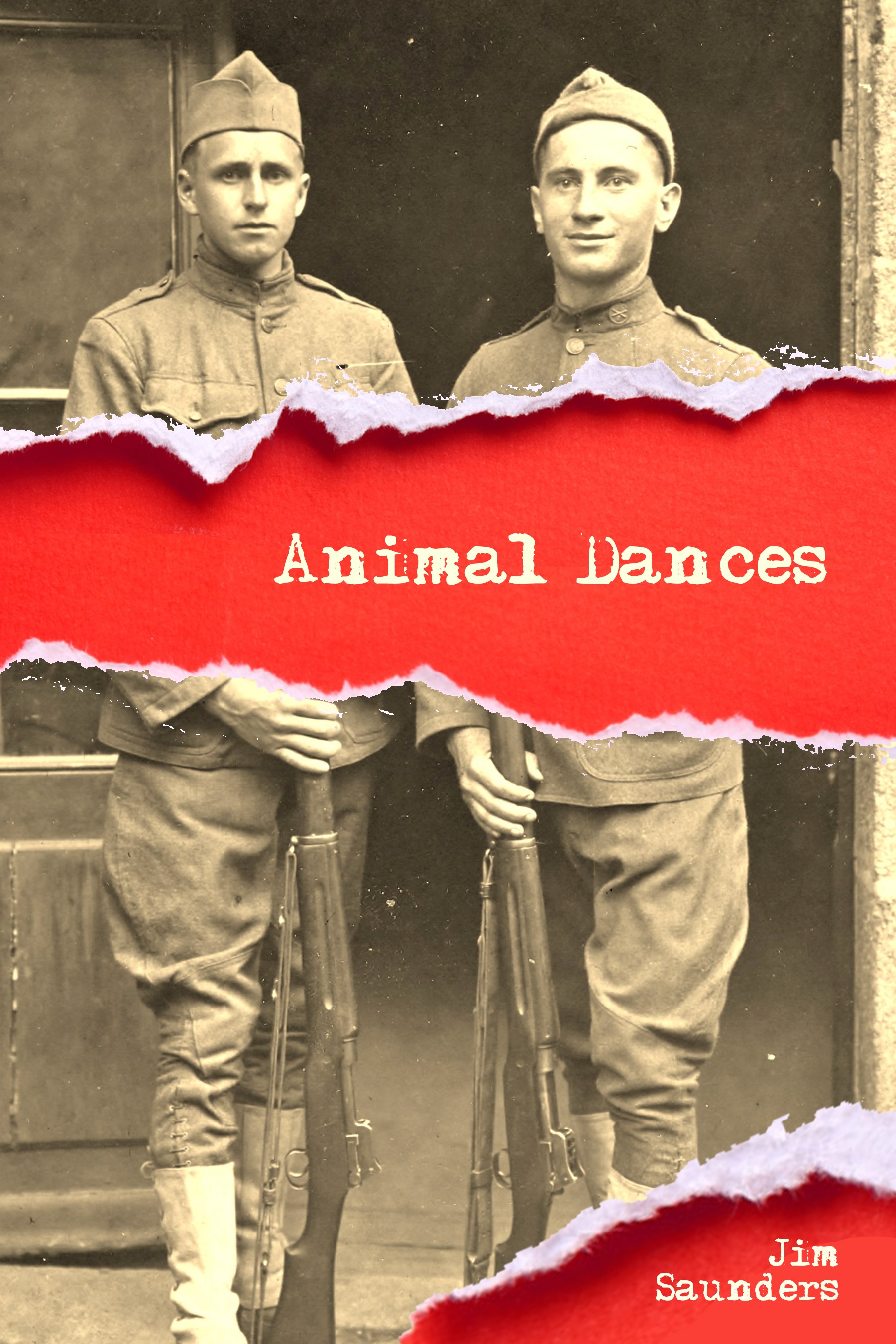 This podcast is an interview with Jim Saunders who is the author of, “Animal Dances.”