
What happens when a lifelong composer, storyteller, educator, and creator decides to bring music, fantasy, visual art, and narration together into a single artistic experience?
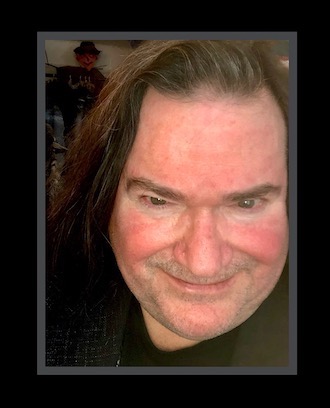
That was one of the central questions explored when Billy Dees welcomed composer and storyteller Christopher Kaufman to the podcast. Kaufman’s work is difficult to place into a single category. His creative life has included composing symphonies and chamber music, performing, teaching, writing fantasy, creating illustrations, producing theatrical works, and developing his ongoing fantasy series, Tales of the Ocean City.
But underneath all of those different forms of expression is one consistent idea: imagination matters.
A Creative Life That Started Early
Kaufman’s relationship with storytelling began when he was a child. He recalls being fascinated by Disney’s The Jungle Book and subsequently creating his own story in which Shere Khan was transformed from a villain into a young tiger seeking revenge against poachers who had killed his family.
That early experiment eventually evolved into illustrated fantasy stories and, later, a much larger imaginative world.
Music became another major part of Kaufman’s life. He attended the New Orleans Center for Creative Arts during high school, studied the oboe, sang bass solos in Handel’s Messiah, and eventually pursued advanced degrees in music composition. His education ultimately took him to Cornell University, where he studied composition with prominent composers.
The interesting part is that Kaufman never really abandoned the storytelling that had occupied his childhood imagination.
Instead, the two creative worlds eventually merged.
When Music and Story Become One
Kaufman describes a turning point that came when he began recording himself narrating his stories while simultaneously composing the music that accompanied them.
That was when, as he describes it, the project “woke up.”
Rather than treating the music as background material for the story, Kaufman began creating the two together. The result became an artistic form that combines storytelling, narration, symphonic music, and visual imagery.
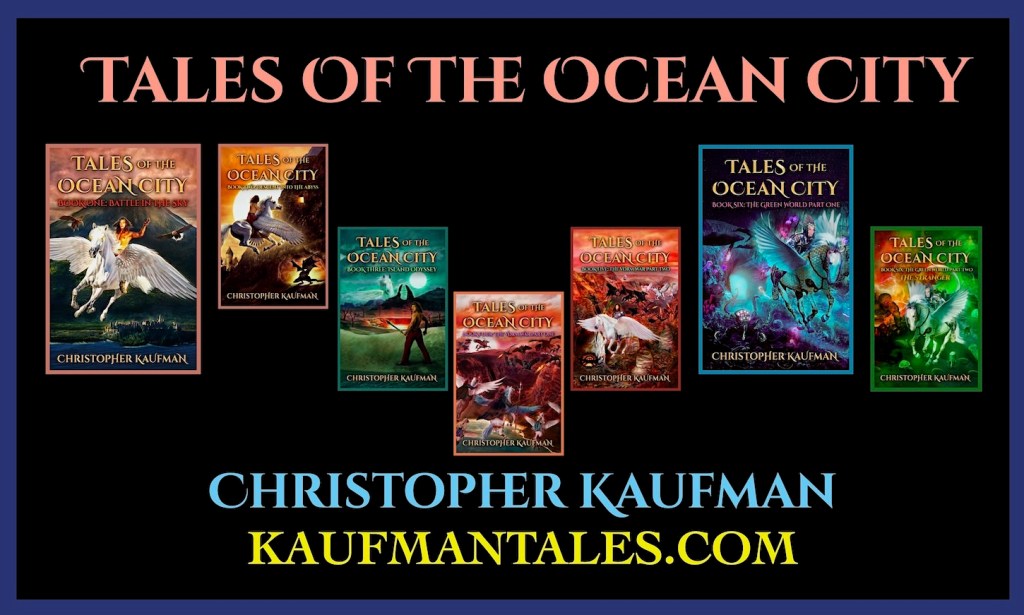
His Tales of the Ocean City project is now being developed across multiple formats. One approach is what Kaufman calls “video books,” in which illustrated pages move along with his narration and original symphonic music.
He has also created a podcast, The Phantastic Worlds of Christopher Kaufman, which combines episodes of Tales of the Ocean City with interviews, readings, discussions of fantasy literature, and musical soundtracks.
It is an interesting example of how modern technology can allow an artist to combine forms that historically existed separately.
Why Classical Music Still Matters
The conversation also turned toward the place of classical and orchestral music in modern culture.
Dees raised a familiar question: Has the public lost some appreciation for orchestral music?
Kaufman’s answer was that exposure plays an enormous role.
He pointed to the decline of music programs and opportunities for students to encounter different forms of music. In his experience teaching in public schools, students who are initially unfamiliar with classical music can become genuinely engaged once they have the opportunity to experience it.
That observation led to another part of Kaufman’s work: his Phantastic Theater concert series, which is designed to introduce audiences—particularly younger audiences—to new music and the arts through a combination of music, visual art, theater, and storytelling.
His philosophy isn’t necessarily that everyone needs to become a professional musician. Instead, the arts can become another way for people to experience the world.
Are We Losing Our Imagination?
Perhaps the most thought-provoking portion of the interview came when Dees and Kaufman discussed the role of imagination in modern childhood.
Dees recalled growing up watching programs such as The Six Million Dollar Man and then running outside and pretending to be the characters. The technology of the time provided the inspiration, but the rest of the experience happened inside a child’s imagination.
Today, entertainment can provide considerably more of the finished product.
Kaufman believes that this distinction is important. When a story is read, for example, the reader must construct the world internally. When a child creates music, draws a picture, or invents a story, that child is exercising the ability to imagine and create rather than simply consume.
Kaufman compares imagination to a kind of mental muscle. Developing it can have applications well beyond the arts, including science, problem-solving, learning complicated skills, and envisioning possibilities for one’s future.
That doesn’t mean technology is inherently bad. Kaufman acknowledges that modern tools can provide tremendous educational benefits. The concern, instead, is balance.
Finding the Arts as an Adult
One of the most encouraging messages from the conversation was that it is never too late to become creative.
Kaufman teaches students of different ages and believes that people don’t necessarily need to turn their artistic interests into careers. In fact, he often encourages people to approach the arts as a meaningful part of life rather than something that must become a profession.
Music, painting, writing, theater, or other creative activities can simply become hobbies.
For Kaufman, the important thing is to participate—to find other positive, encouraging people who are interested in creating and allow the creative process to become part of everyday life.
He also describes the physical and emotional experience of making music, particularly when playing an instrument such as the cello. The experience involves the senses, emotions, intellect, and imagination simultaneously.
That combination, he argues, is part of what makes the arts uniquely human.
Fantasy Isn’t Just Escapism
Kaufman’s love of fantasy literature also provided an important perspective.
He discusses author Lloyd Alexander, particularly The Chronicles of Prydain, as a major influence. What Kaufman finds particularly powerful about Alexander’s work is the depth of its emotional content. Writing for younger audiences, Alexander didn’t necessarily make his themes smaller or simpler. Instead, the emotional stakes could become larger and more powerful.
Kaufman sees fantasy as much more than an escape from reality.
Fantasy can actually provide a different way of examining reality.
Characters, creatures, imaginary worlds, and heroic quests can become metaphors for the struggles people experience in their own lives. The courage of a fictional character can inspire courage in the reader. A character facing an impossible challenge can give someone a different perspective on a challenge in their own life.
In that sense, fantasy becomes a tool for understanding the human experience.
When Technology Starts Thinking for Us
The discussion eventually moved into one of the most relevant questions of the interview: artificial intelligence.
Dees expressed concern that the greatest danger of AI may not be some dramatic scenario in which machines suddenly take over the world. Instead, the more subtle danger may be people gradually allowing technology to replace their own thinking.
Kaufman sees similar concerns among young people. He described seeing students rely heavily on AI for schoolwork and suggested that excessive dependence can interfere with reading, thinking, learning, and intellectual development.
At the same time, Kaufman makes an important distinction between technology as a tool and technology as a substitute for human creativity.
He compares today’s digital tools with earlier technological advances. Composers once had to copy orchestral parts by hand. The Xerox machine made that process easier. Today, Kaufman uses software such as Sibelius to produce scores rather than writing every part by hand.
The technology assists with the mechanics.
It doesn’t compose the music for him.
That distinction may be at the heart of the AI conversation.
Technology can make creative work easier without necessarily becoming the creator.
The Human Need to Create
Perhaps the biggest takeaway from the conversation between Billy Dees and Christopher Kaufman is that creativity isn’t merely entertainment.
It is part of how human beings understand themselves and the world around them.
Music teaches people to listen. Writing teaches people to imagine. Painting teaches people to see. Storytelling allows people to explore ideas and emotions from different perspectives. Fantasy can provide a safe environment for confronting enormous questions about courage, morality, loss, friendship, and purpose.
And perhaps most importantly, creating something requires participation.
In an increasingly digital world where more and more experiences are delivered to us fully formed, Kaufman’s message is a reminder to leave some room for the imagination.
Read the book instead of watching the adaptation.
Pick up an instrument.
Draw something.
Write a story.
Listen to music you don’t immediately understand.
Or simply look at a cracked parking lot and imagine the forest that might have been there.
The point isn’t necessarily to become an artist.
The point is to keep exercising the part of ourselves that can imagine what isn’t there yet.
That may be one of the most important creative abilities we have.
Christopher Kaufman’s work brings that idea together through Tales of the Ocean City, his music, his storytelling, his teaching, and his ongoing exploration of what happens when different art forms meet. His conversation with Billy Dees ultimately becomes something larger than a discussion about fantasy or classical music.
It’s a conversation about what makes us human—and what we risk losing when we stop creating.