
Rage Bait, Political Miscalculations, Media Hypocrisy, and the Business of Keeping America Divided

Billy Dees and Cynthia Elliott tackle the midterm elections, political strategy, the attention economy, celebrity controversies, AI industry concerns, and the cultural debates shaping America and Europe.
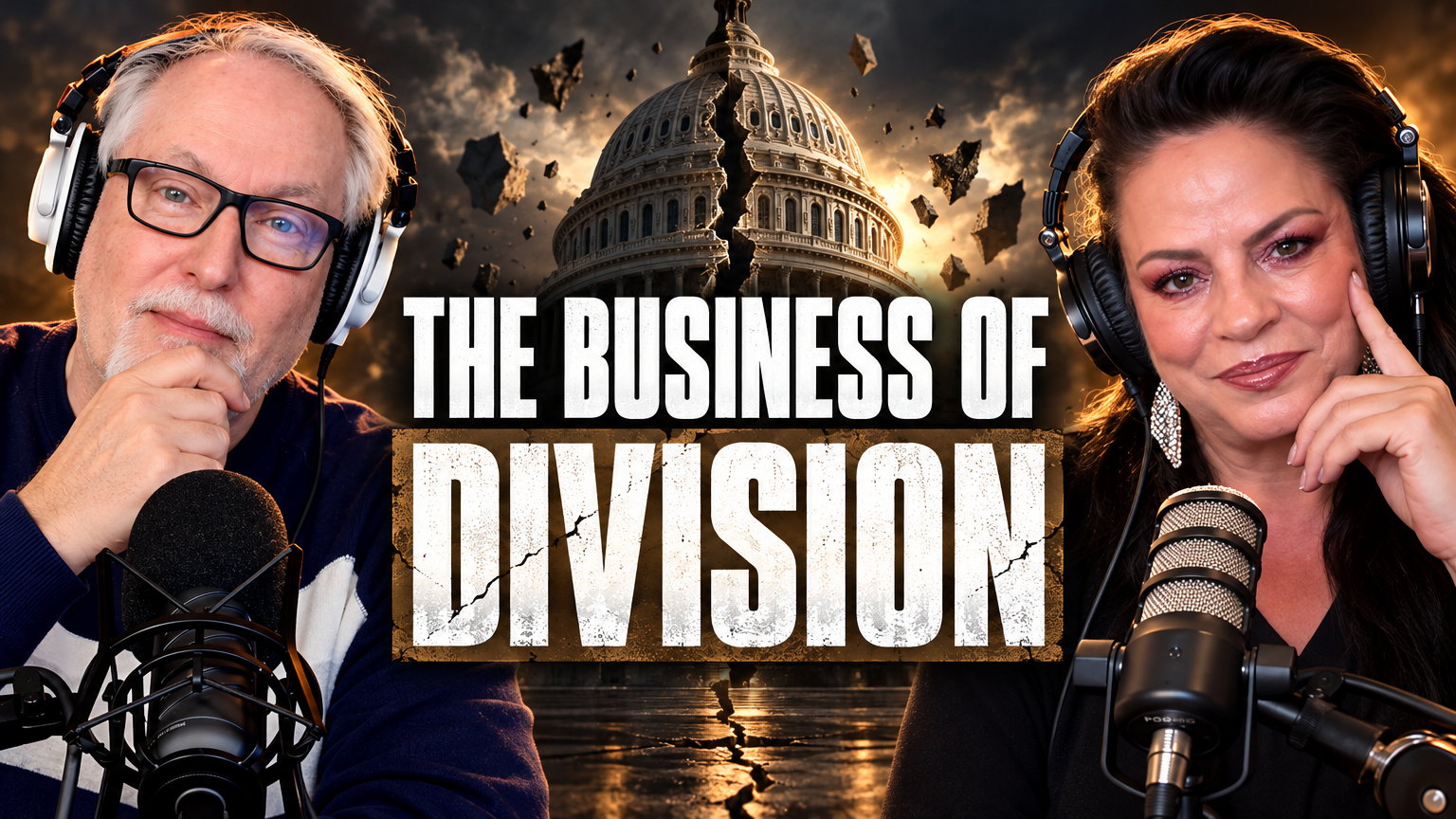
Podcast graphic featuring two hosts wearing headphones beside microphones, the U.S. Capitol in the background, and the title “The Business of Division.”

If there is one thing we seem to have an unlimited supply of these days, it’s outrage. Turn on the television, scroll through social media, or spend five minutes following the latest political controversy, and you’ll quickly discover that somebody is offended, somebody is being canceled, somebody is being accused of something, and somebody else is making money from all of it.

Welcome to the attention economy, where keeping people angry has become a remarkably effective business model.

On this episode of the Billy Dees Podcast, I am joined by returning guest Cynthia Elliott for a wide-ranging conversation that covers politics, media, culture, technology, and some of the increasingly uncomfortable questions facing American society.

We begin with the recent midterm elections and the political landscape, including the closely watched Ohio governor’s race between Amy Acton and Vivek Ramaswamy. The election provides an opportunity to examine more than just the results. We get into campaign strategy, candidate personalities, political branding, and the decisions that can make or break a campaign.

The Ohio race was particularly interesting because neither candidate generated overwhelming enthusiasm from everyone watching. We discuss the baggage each candidate brought into the race, the influence of wealth and political money, and the controversy surrounding the use of Amy Acton’s estranged mother in a campaign advertisement.

Regardless of where someone stood politically, the decision to use that particular family history as campaign material raised legitimate questions about judgment, strategy, and the boundaries of political campaigning. Sometimes a campaign doesn’t need its opponent to make a mistake. It simply needs to avoid making one itself.

And then there is the increasingly familiar problem of candidates who struggle with their own public image. Being wealthy, successful, or politically ambitious doesn’t automatically translate into leadership ability. Thin skin, arrogance, and an inability to read a room can be liabilities, particularly when voters are looking for someone they can trust.

The Media’s Outrage Machine

From politics, we move into something that has become almost impossible to avoid: rage bait.

A viral Ring camera video involving college students at Ole Miss becomes a national news story, raising questions about racial assumptions, social media amplification, and the speed at which public judgment is delivered.

There is a difference between calling out genuinely offensive behavior and turning every incident into a national referendum on American society. Context matters. Facts matter. And perhaps most importantly, the ability to distinguish between what we know and what we assume seems to be disappearing.

Cynthia and I discuss the role of legacy media in turning isolated incidents into larger cultural confrontations. Is the goal to inform the public, or is it to generate another round of outrage that keeps viewers watching?

The business model is not particularly complicated. Find something that makes people angry, give it a dramatic presentation, divide the audience into opposing camps, and let the argument continue on social media long after the original story has disappeared.

As I point out during the conversation, there are people on both sides of the political spectrum who have built careers around positioning themselves as protectors against some great threat. Their business depends on keeping that threat alive.

Cynthia makes an interesting observation: if Americans could find a way to stop treating each other as political enemies, a lot of people in the outrage business might suddenly find themselves looking for another line of work.

Perhaps it’s time to spend a little less energy fighting over red and blue and a little more time finding some purple in the middle.

Dave Chappelle, Comedy, and the Attention Economy

We also get into the controversy surrounding comedian Dave Chappelle and some of his recent remarks, including comments involving Charlie Kirk.

There was a time when comedy could push boundaries, offend people, and still make an audience think. Richard Pryor and George Carlin were masters of that particular art. They could make people laugh at something uncomfortable and then leave them thinking about what they had just heard.

But there is a difference between being provocative and simply trying to provoke.

Cynthia and I discuss how the attention economy has changed entertainment. Controversy generates attention, attention generates publicity, and publicity can translate into ticket sales, subscriptions, and revenue.

At some point, audiences have to ask themselves whether they are watching someone who is genuinely being funny or someone who has figured out that saying something outrageous is an effective way to stay relevant.

Not every controversial statement deserves a national discussion. And not every celebrity controversy deserves our participation.

Sometimes the best response is simply to move on.

Technology, Nvidia, and the Security Questions Behind Personal Decisions

The conversation takes another turn when Cynthia brings up developments surrounding Nvidia and allegations involving its leadership and a possible connection to Chinese intelligence.

The discussion explores the potential implications of personal relationships, corporate leadership, and national security, particularly when executives occupy positions of enormous influence within strategically important technology companies.

There is an important distinction between someone’s private life and decisions that could expose a company or sensitive information to outside influence.

When you’re operating at the highest levels of the technology industry, personal judgment can have consequences that extend well beyond your own household.

We discuss the risks associated with workplace relationships, executive behavior, corporate security, and the possibility that personal vulnerabilities can become organizational vulnerabilities.

In an industry as strategically important as artificial intelligence, those questions deserve serious attention.

The conversation also connects to Cynthia’s broader work through SoulTech, where her focus is human flourishing in the age of AI. As artificial intelligence becomes increasingly integrated into business, government, and everyday life, the human decisions surrounding that technology may prove just as important as the technology itself.

Immigration, Religion, and Europe’s Cultural Debates

One of the more contentious portions of the conversation involves immigration, religion, assimilation, and the cultural changes taking place throughout Europe.

Cynthia expresses strong concerns about what she sees as a growing disconnect between certain progressive political movements and the historical and cultural realities surrounding religious extremism, women’s rights, and individual freedoms.

We discuss the distinction between respecting someone’s right to practice a religion and examining political or ideological movements that may conflict with the principles of an open society.

These are difficult subjects, and they deserve more than slogans or accusations designed to shut down discussion.

Criticism of religious extremism should not automatically become hostility toward every individual who practices a particular faith. At the same time, protecting religious freedom does not mean abandoning the ability to question religious institutions, political movements, or cultural practices.

We also touch on the different approaches European nations have taken toward immigration, with particular attention to Poland, France, Germany, and the United Kingdom.

What happens when immigration policy, national identity, public safety, and cultural expectations collide? And what happens when governments appear unwilling or unable to have an honest conversation about the consequences?

These are questions that extend well beyond any single election or political party.

The Bigger Question: Who Benefits From All This Division?

One of the recurring themes throughout this episode is the relationship between attention, money, and manufactured outrage.

Whether we’re talking about political campaigns, cable news, celebrity controversies, social media personalities, or cultural disputes, there is often a financial incentive behind keeping people emotionally invested.

The more people argue, the more attention the argument receives. The more attention it receives, the more valuable it becomes.

And somewhere along the way, the actual issues that affect people’s lives get lost in the noise.

There is plenty to criticize on both sides of the political aisle. There are legitimate disagreements about immigration, economics, government, religion, technology, and the direction of the country. But meaningful discussion requires something that seems increasingly difficult to find: a willingness to examine issues without automatically treating everyone who disagrees as an enemy.

We cover a lot of ground in this conversation, and we certainly don’t agree on every subject. That’s part of the point.

Join Billy Dees and Cynthia Elliott for this wide-ranging episode covering politics, media manipulation, cultural controversies, artificial intelligence, and the increasingly complicated world we’re all trying to navigate.

Because if we’re going to spend this much time paying attention to the news, we might as well do a little thinking while we’re at it.

Also, a note for listeners:

We are now making our video presence known on Rumble. Please feel free to follow us there.

Herman Forwood on History, Political Tribalism, Government, and the Danger of Accepted Ideas

A promotional image featuring author Herman Forwood beside three book covers: 'Echoes of the Ancients,' 'Twilight of Democracy,' and 'Secrets & Murders.' Each book represents different genres: thriller/mystery, alternate history, and murder mystery/dystopian fiction. The background has a dark map design, and the text encourages exploring the books at HermanForwood.com.

What happens when we stop questioning the world around us? On this episode of The Billy Dees Podcast, Billy Dees sits down with author and podcaster Herman Forwood for a wide-ranging conversation about history, political division, modern government, international relations, and the growing influence of artificial intelligence. The discussion challenges listeners to look beyond familiar talking points and consider whether the ideas we accept as conventional wisdom deserve a closer examination.

Forwood is a lifelong student of history who takes an unconventional approach to exploring society. Rather than telling people what to think or forcing contemporary events into convenient historical comparisons, he uses thought experiments and fictional scenarios to challenge assumptions. His goal is not necessarily to provide definitive answers, but to encourage people to ask better questions.

And in a time when political discussions often resemble competing monologues rather than genuine conversations, that approach may be more valuable than ever.

When History Becomes a Political Weapon

One of the central themes of the conversation is how people use history to support what they already believe. Few historical figures are invoked as casually in modern political debate as Adolf Hitler. As Billy points out, comparing someone you dislike to Hitler has become a familiar rhetorical shortcut, often without much consideration of historical context.

Forwood argues that history is more complicated than simply identifying a past event that resembles something happening today. People can cherry-pick facts, select convenient comparisons, and construct arguments that reinforce their existing positions. The same historical record can be used to support opposing conclusions.

The conversation explores a deeper question: If societies repeatedly claim to have learned from history, why do they continue to make similar mistakes?

The Vietnam War, the Iraq War, and the consequences of foreign intervention provide examples for examining whether policymakers truly absorb the lessons of previous conflicts. Rather than declaring that two wars are identical, Forwood encourages a more productive discussion about the underlying decisions, assumptions, and institutional failures that can lead to repeated problems.

The challenge is not simply remembering what happened. It is understanding why people and institutions continue to make decisions that produce familiar consequences.

Political Bubbles and Competing Realities

Billy and Herman also examine the growing difficulty of having constructive conversations across political and ideological lines.

Man with dark hair and a trimmed beard, wearing a black shirt with blue accents, standing outdoors with arms crossed, smiling against a blurred natural background.
Herman Forwood

Billy reflects on an earlier era of American politics when political opponents could disagree sharply while still operating within a broadly shared understanding of the problems facing the country. Today, he worries that people increasingly inhabit separate information environments, where even basic facts and assumptions are disputed.

Forwood agrees that political tribalism has become a serious obstacle to meaningful discussion. In his view, the problem is not merely that people belong to different political camps. It is that someone’s argument may be rejected before it is even considered simply because it comes from the perceived opposing side.

That creates a troubling dynamic: A person can make a valid point about a shared problem, yet the point itself becomes irrelevant because of who is making it.

When political identity determines what someone is willing to accept as true, productive disagreement becomes increasingly difficult. The conversation asks whether people can recover the ability to examine ideas on their merits rather than automatically defending the positions of their preferred political tribe.

Can Fiction Make Us Think Differently?

Forwood’s approach to writing offers another way to explore these issues. He believes fiction can challenge social conventions in ways that straightforward commentary sometimes cannot.

His upcoming dystopian murder mystery, Murders and Secrets and Murders, grew in part from his observations about homeowners associations and the social dynamics of suburban communities. After moving from big-city life to the suburbs, Forwood became interested in the tribalism and boundaries that can develop even within seemingly ordinary neighborhoods.

His thought experiment takes the homeowners association concept several steps further. What if communities were organized around religion, intelligence, occupation, or other defining characteristics? What if living in one of these communities became the norm, while people who could not afford membership were left outside?

The premise is not simply an attack on homeowners associations. Instead, it asks readers to consider what happens when familiar social arrangements are expanded to their logical extremes.

A murder mystery provides a particularly useful vehicle for this exploration because the search for truth can expose the hidden tensions and darker realities beneath an apparently orderly society.

Forwood sees fiction as an opportunity to make readers reconsider ideas they might otherwise accept without question. Rather than delivering a lecture, a story can place readers inside an unfamiliar world and let them examine the consequences for themselves.

What Is the Role of Government in the Modern World?

The discussion then moves into one of its broadest subjects: whether Western governments are adapting to the societies they are supposed to serve.

Forwood questions whether political institutions designed in very different historical circumstances can adequately address the expectations and challenges of modern life. He points to growing public disengagement and the tendency for voters to swing between political extremes as signs that something may not be working as intended.

Billy adds a discussion of the American constitutional system, representative government, and the safeguards designed to prevent majority rule from becoming unchecked power.

The conversation also explores the differences between political systems and the assumption that one model of democracy can simply be exported to every society.

Examples involving Singapore, Norway, Iran, Iraq, and the Palestinian elections illustrate the complications of defining democracy and predicting its outcomes. An election may be conducted fairly without producing the result that outside observers prefer. A political system that works in one country may not translate easily into another with a different history, culture, or set of institutions.

The larger question is whether governments and their citizens are willing to discuss these complexities honestly.

Neither host nor guest offers a simple blueprint for reform. Instead, the emphasis is on asking whether political institutions are solving real problems and whether public debate has become too constrained by ideological labels to consider alternatives.

The Complicated Business of International Relationships

Foreign policy provides another opportunity to examine the gap between political rhetoric and real-world consequences.

Billy and Herman discuss the concept of frenemies—countries or political actors that may cooperate with the United States in certain circumstances while pursuing interests that conflict with American objectives in others.

The conversation revisits relationships involving Saddam Hussein, Saudi Arabia, Russia, and other international players, as well as the unintended consequences that can follow when governments support or empower particular actors for short-term strategic reasons.

Forwood argues that managing these relationships requires judgment, careful prioritization, and an understanding that international interests can change. Decisions made by one administration can create problems that subsequent administrations must confront.

The discussion also considers the influence of presidential advisers and the challenge of determining which recommendations will prove wise over time.

Foreign policy is rarely as simple as identifying friends and enemies. The difficult work lies in recognizing competing interests, anticipating consequences, and deciding when cooperation is useful—and when it becomes dangerous.

Artificial Intelligence: Innovation, Infrastructure, and Risk

Toward the end of the interview, Billy introduces a subject that is becoming increasingly difficult to ignore: artificial intelligence.

The discussion considers the potential for AI to be used by malicious actors, the vulnerabilities of critical infrastructure, and the challenges governments face in responding to rapidly advancing technology.

Forwood takes a critical look at today’s AI systems, arguing that current models should not be confused with human-like understanding or intelligence. He questions the enormous computing resources they require and suggests that the technology’s limitations are an important part of the public conversation.

He also challenges the assumption that regulation alone can eliminate the risks. Rules may create safeguards, but they cannot necessarily prevent determined bad actors from exploiting technology or guarantee that every possible danger has been anticipated.

Billy raises a related concern: Once powerful technology becomes widely available, attempting to prohibit it may not prevent hostile governments or individuals from developing and using it.

The exchange highlights a difficult balancing act. How do societies encourage useful innovation while preparing for misuse, infrastructure threats, and consequences that may not yet be fully understood?

It is a question that extends beyond the technology industry into national security, public policy, and the responsibilities of political leadership.

The Value of Asking Better Questions

What connects all these subjects—from historical comparisons and political polarization to dystopian fiction, government, foreign policy, and artificial intelligence—is a willingness to question accepted assumptions.

Herman Forwood is not presenting a single ideological answer to every problem. His approach is to examine familiar ideas, explore what might happen if they were taken further, and encourage readers and listeners to think through the implications.

That approach also reflects the spirit of The Billy Dees Podcast: thoughtful conversations that prioritize substance over political theater.

In an environment where every issue seems to demand an immediate opinion, perhaps one of the most useful things we can do is slow down long enough to examine the assumptions behind it.

History can inform us, but only if we are willing to look beyond the examples that confirm our beliefs. Fiction can challenge us, but only if we allow ourselves to consider uncomfortable possibilities. Democracy can function, but meaningful participation requires more than choosing a side and defending it at all costs. And technology can offer extraordinary possibilities while introducing risks that demand serious consideration.

The question is not whether everyone will agree. It is whether we can still have conversations that make disagreement worthwhile.

Listen to the full conversation with Herman Forwood on The Billy Dees Podcast. Explore the ideas, consider the thought experiments, and decide for yourself which assumptions deserve another look.

To learn more about Herman Forwood, explore his writing, essays, books, and other work at hermanforwood.com.

When Activism Collides With Science: Billy Dees Talks Evolution, Ideology, and Truth With Dr. Marc J. Defant

Dr. Marc J. Defant

In this episode of The Billy Dees Podcast, Billy sits down with Dr. Marc J. Defant, a professor of geology and geochemistry at the University of South Florida whose work bridges the physical sciences and evolutionary psychology. With publications in top-tier journals like Nature and funding from organizations such as the National Science Foundation and National Geographic, Dr. Defant brings serious scientific credentials to a conversation that tackles one of the most controversial issues of our time: what happens when ideology begins to override evidence in academia.

Dr. Marc J. Defant has been on shows like the Joe Rogan Experience and the Dinesh D’Souza Podcast, and on this episode, he talks to Billy.

The discussion spans far beyond surface-level culture war talking points. Dr. Defant explains how evolutionary psychology emerged from biology and why human behavior—including sex differences, mate selection, competition, and social roles—cannot be explained by culture alone. Drawing from anthropology, neuroscience, and cross-cultural data, he outlines how traits like masculinity and femininity are deeply rooted in our evolutionary past, shaped over hundreds of thousands of years in hunter-gatherer societies. Billy pushes the conversation into real-world implications, exploring how modern debates over gender, masculinity, pay gaps, and social expectations often ignore biological realities in favor of politically convenient narratives.

What makes this episode stand out is its willingness to ask uncomfortable questions without demonizing individuals. Billy and Dr. Defant emphasize the importance of balance: acknowledging discrimination where it exists, while also rejecting the idea that society is governed by hidden systems designed to oppress. They discuss how concepts like “toxic masculinity,” social constructionism, and the politicization of psychology may be doing more harm than good—especially to young men navigating identity, purpose, and responsibility in an increasingly hostile cultural climate.

Ultimately, this conversation is about intellectual honesty. From the evolution of the human brain to modern academic institutions, Billy Dees and Dr. Marc Defant argue that truth matters more than ideology—and that science loses its value the moment it becomes activism in a lab coat. It’s a thoughtful, wide-ranging discussion that challenges listeners to reconsider what they’ve been told, ask better questions, and remain open to evidence, even when it’s inconvenient.

If you’re interested in long-form conversations that don’t shy away from complexity, this is an episode you won’t want to miss.

Questioning Narratives, Media Power, and Due Process: A Deep Conversation with Filmmaker, Sara Alessandrini

Sara Alessandrini

In this episode of The Billy Dees Podcast, Billy sits down with Italian filmmaker and social commentator Sara Alessandrini for a wide-ranging, thoughtful discussion that cuts to the heart of today’s political and cultural tensions. Sara is the creator of the docu-series This Is What New Yorkers Say, a multi-episode project examining the rise and fall of former New York Governor Andrew Cuomo, the role of legacy media, and the broader consequences of a culture increasingly driven by outrage rather than evidence. What begins as a discussion about one political figure quickly evolves into a much deeper examination of media narratives, public opinion, and the erosion of nuanced discourse.

Sara shares her journey from Italy to the United States, explaining why America’s openness to reinvention, entrepreneurship, and reinvention drew her in. From that international vantage point, she offers a perspective that many Americans rarely hear—one shaped by lived experience in Europe, where government systems, labor protections, immigration policies, and social safety nets often function very differently than how they are idealized in U.S. political debates. Throughout the conversation, she challenges both left- and right-wing orthodoxies, arguing that good intentions do not always lead to good outcomes, especially when long-term consequences are ignored.

At the center of the discussion is Sara’s documentary work on Cuomo and the broader implications of how accusations are handled in the court of public opinion. She raises difficult but necessary questions about due process, the limits of movements like #MeToo, and what happens when standards are lowered to the point where perception outweighs evidence. Billy and Sara explore how media amplification can rapidly transform public figures from heroes to villains, often without space for facts, context, or proportionality. The conversation also expands into topics like political polarization, the breakdown of shared reality, immigration, socialism versus capitalism, and the growing sense that society has lost the ability to have honest, good-faith disagreements.

This episode is not about defending any one politician or ideology—it’s about encouraging critical thinking, resisting manipulation, and reclaiming the ability to ask uncomfortable questions without fear of social exile. Thought-provoking, candid, and at times challenging, this conversation is a must-listen for anyone concerned about the future of media, democracy, and civil discourse. Sara Alessandrini brings a rare blend of intellectual honesty and international perspective, making this a substantive and reflective episode.

Discover Why Now is the Best Time of Your Life! 🎙️

Have you ever found yourself trapped in nostalgia, reminiscing about the “good old days?” Billy Dees dives deep into this sentiment in this episode “The Best Time of Your Life is Right Now!”

In this thought-provoking episode, Billy explores a powerful truth: our past may seem inviting, but it doesn’t hold a candle to the opportunities we have today. Life is fleeting, and the only guarantee we have is this very moment. Imagine making the most of your time, creating incredible memories right now!

Here’s what you’ll discover:

The Dangers of Nostalgia:

Why longing for past moments can actually hinder your present happiness.

The Reality of Time:

Understand just how quickly time passes and learn to appreciate every second.

Creating Value in the Now:

Billy shares insights on how helping others can enrich your own life experience.

Real Talk on Mortality:

Embrace your awareness of life’s brevity as a tool for better living today.

You’re invited to challenge the way you think about your memories and learn to savor the here and now. Whether you’re feeling stuck in past regrets or worried about the future, this episode offers practical advice on how to reclaim your life in the present!

So, what’s in it for you? By tuning in, you’ll equip yourself with a fresh perspective. Plus, you’ll hear Billy’s take on pop culture and social media influencers, providing a modern spin on age-old wisdom!

Ready to turn your “what ifs” into “what’s next”? Join us for this empowering episode, and let’s make your current moments extraordinary!

Catch the full conversation now on the Billy Dees Podcast on your favorite platform or below: